
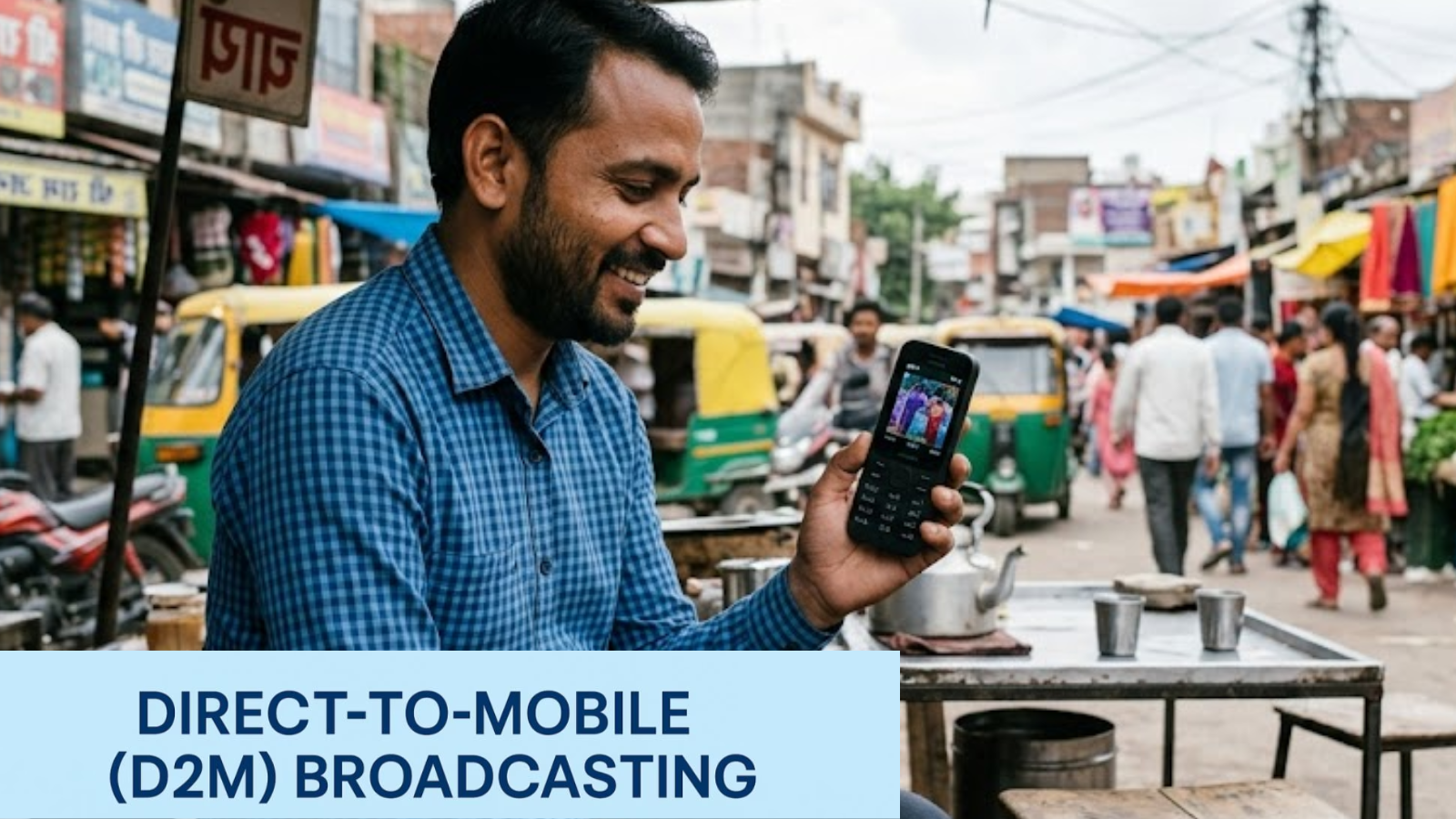
Imagine you’re mid-journey, your data pack hits zero, yet your favorite show or a live match keeps playing without a glitch. That’s the promise of Direct-to-Mobile (D2M) technology, which just finished a successful trial run in Delhi. It’s a major shift in how we think about staying connected without tethering ourselves to mobile networks.
The tests, conducted alongside Tejas Networks, proved that video and audio can beam directly to your phone without eating up a single megabyte of data. Beyond just saving you money, this tech could become a vital tool for broadcasting emergency alerts when traditional networks get overwhelmed.
Key features of D2M
- No internet needed: Watch shows without burning through data or hunting for Wi-Fi.
- Direct broadcast: Content streams straight to your device using satellite or broadcast signals.
- Lightens the load: Takes the heavy traffic off mobile networks, easing congestion.
- Emergency alerts: Delivers crucial warnings during natural disasters, even if the network is down.
- Lower costs: Since it doesn’t rely on data plans, high-quality entertainment becomes much cheaper.
How does D2M work?
Think of D2M as a hybrid between traditional broadcasting and mobile broadband. It acts like a bridge, sending signals straight from the source to your phone’s built-in receiver.
It works much like the antenna on your rooftop TV, but optimized for your smartphone. By blending telecom towers with existing broadcasting infrastructure, it creates a path for content that bypasses the standard data pipeline entirely.
What the testing revealed
The Delhi trials used specialized hardware from Tejas Networks to put the concept to the test. Whether in a lab setting or out in the real world, the results consistently outperformed expectations.
“The success of these D2M trials suggests we’re looking at a complete shift in how India consumes digital content. Watching videos without an internet connection is no longer just a theory.”
Streaming vs. D2M
Here is how the old way of streaming compares to the new D2M approach:
| Feature | Traditional Streaming (OTT) | D2M Technology |
|---|---|---|
| Internet required | Yes | No |
| Data usage | High | Zero |
| Video quality | Network dependent | Stable and high |
| Cost | Paid data plans | Free/Broadcast-based |
Why this matters
In a country as vast as India, internet access isn’t always reliable. For rural areas where mobile data is often slow or patchy, D2M could be a genuine lifesaver.
- Entertainment becomes accessible to everyone, everywhere.
- Educational content reaches students without the barrier of data costs.
- Government updates and public safety notices can reach millions instantly, regardless of network status.
Frequently Asked Questions
Will I need a SIM card to use D2M?
Early reports suggest that while you’ll still have a SIM card, your phone will need specific hardware to receive these signals. Eventually, this will likely be built into most smartphones.
Is this a paid service?
It’s a broadcast model, similar to how TV works. You won’t need a monthly data recharge to access the content, making it effectively free to receive.
Can I watch my favorite shows?
Yes. Broadcasters will push their channels and programs through this system, giving you access to live news, sports, and entertainment.
Will my current phone support this?
Probably not yet. Most existing smartphones lack the specific D2M receiver, so manufacturers will need to include the right chipsets in their future models.
Does this hurt my mobile internet speed?
It’s actually the opposite. By moving video traffic off the mobile network and onto the D2M broadcast path, it frees up bandwidth for everyone else, which could actually improve your overall internet speed.
Final thoughts
The successful trial in Delhi marks a turning point for India’s digital future. It isn’t just about watching TV on the go; it’s about solving the connectivity gap for millions of people.
Once this hits the market, we’ll fundamentally change how we use our phones. The era of watching content without worrying about your data balance is closer than you think.
Source: navbharattimes.indiatimes.com